DAY 1: Emmanuel - God With Us
Core Truth: God chose presence, not distance.
1. FOUNDATION VERSES
"Behold, the virgin shall become pregnant and give birth to a Son, and they shall call His name Emmanuel—which, when translated, means, God with us." Matthew 1:23 (AMPC)
"And the Word (Christ) became flesh (human, incarnate) and tabernacled—fixed His tent of flesh, lived awhile—among us; and we [actually] saw His glory (honor, majesty, and splendor), such glory as an only begotten son receives from his father, full of grace (favor, loving-kindness) and truth." John 1:14 (AMPC)
"And the Lord said, My Presence shall go with you, and I will give you rest." Exodus 33:14 (AMPC)
The Message
The name Emmanuel is the foundation of our faith. It is not just a title but a statement of truth, a declaration of God's ultimate desire. From the Hebrew roots for "God" (El) and "with us" (immanu), this name announces relationship before authority and companionship before command. It overturns every image of a distant, unreachable ruler and reveals a Savior who chose to come down, draw near, and walk beside those He loves. This is the good news: the God who made everything has entered human life.
This promise of nearness is a pattern woven throughout Scripture. God walked with Adam and Eve in Eden, led Israel by a pillar of cloud and fire, and filled the tabernacle with His glory. To Moses, who felt the weight of leading a rebellious people, God did not offer a complex strategy; He offered the most personal promise possible: "My Presence shall go with you." He promised His panay, His very face, signifying direct, personal, attentive involvement—not that of a mere representative. God promised to turn His face toward His people.
This ancient promise finds its ultimate fulfillment in Jesus. When John wrote that Jesus “tabernacled” among us, he used a word—eskēnōsen—that would have sent a shockwave through his Jewish readers. He was declaring that the awesome, tangible Presence of God that once filled a sacred tent in the wilderness was now, impossibly, contained in the skin of a man. The eternal Logos—the divine reason and very expression of God—had become flesh, pitching His tent among His people not in fabric and gold, but in human skin.
Advent invites us to wonder again at this impossible truth. The manger was not mere decoration; the vulnerability was real. The God who flung stars into space was content to be held in human arms. This is Emmanuel—God choosing nearness over distance. To receive Him is to accept a new reality: you do not face life alone. His presence is not symbolic; it is tangible. His nearness is not occasional; it is covenant. He has made an eternal decision to be with you, which leads us to the profound mystery of how He came to be with us, in the Word made flesh.
Reflection & Application
Living with Emmanuel changes everything. For the lonely, it is the assurance that you are never truly alone. For the fearful, it is the quiet confidence that the One who is with you is greater than anything you face. For the weary, His presence is rest. His nearness means that God enters your pain not to explain it from a distance, but to share it from within.
- In what area of your life do you most need to be reminded that you are not alone?
- How does knowing God chose nearness over distance change the way you approach Him in prayer?
- How can you become more aware of His tangible, moment-by-moment presence with you today?
Dear Father, thank You for the incredible gift of Your presence. Forgive me for the times I live as if I am alone. Open my eyes and my heart to see and feel Emmanuel, God with me, in every part of my day. Amen.
2. THE PATTERN OF GOD'S PRESENCE
Throughout Scripture, God reveals Himself as the God who draws near:
In Eden: God walked in the garden in the cool of the day, seeking fellowship with Adam and Eve (Genesis 3:8).
With Israel: The pillar of cloud and fire demonstrated God's visible presence leading His people through the wilderness (Exodus 13:21-22).
In the Tabernacle: God's glory filled the tent of meeting, dwelling in the midst of Israel's camp (Exodus 40:34-38).
Through the Prophets: God spoke "mouth to mouth" with Moses (Numbers 12:8) and revealed Himself to the prophets.
In Christ: The Word became flesh and lived among us - the ultimate expression of divine nearness (John 1:14).
By the Spirit: Jesus promised another Comforter who would abide with us forever (John 14:16-17).
In Eternity: God Himself will dwell with His people in the new creation (Revelation 21:3).
God Chose to Come Down
Emmanuel represents the amazing reality that the infinite God chose to limit Himself for the sake of relationship. The Creator entered creation. The eternal One entered time. The invisible became visible. The Word became flesh.
This is not God observing humanity from heaven. This is God experiencing humanity from within. He knows hunger because He fasted. He knows weariness because He slept. He knows temptation because He was tempted. He knows sorrow because He wept. He knows betrayal because Judas kissed Him. He knows death because He died.
Emmanuel is God saying: "I will not ask you to walk a road I have not traveled. I will not demand from you what I have not given. I will not remain distant from what I call you to endure."
3. PRACTICAL APPLICATION
Living With Emmanuel
For the Lonely: You are never alone. The God who promised "I am with you" has not changed His commitment. His presence is not dependent on your feelings or circumstances.
For the Fearful: Perfect love casts out fear (1 John 4:18). When you understand that omnipotent love walks beside you, what remains to fear?
For the Weary: His presence brings rest (Exodus 33:14). Not the rest of inactivity, but the rest of knowing He carries what you cannot.
For the Inadequate: His presence qualifies you. Moses objected to his calling until God promised, "Certainly I will be with you" (Exodus 3:12).
For the Suffering: He enters your pain, not to explain it but to share it. Emmanuel means God suffers with those who suffer.
4. ADVENT MEDITATION
Emmanuel is Christmas stripped to its essence. Before the angels sang, before the shepherds came, before the wise men presented gifts - there was this: God with us.
The manger was not decoration. The poverty was not staged humility. The vulnerability was real. God truly came near, near enough to be touched, near enough to be rejected, near enough to die.
Advent invites us to wonder again at this impossible truth: the God who flung stars into space was content to be held in human arms. The God who commands galaxies submitted to Mary's care. The God who owns everything entered the world owning nothing.
This is love beyond comprehension. This is glory wrapped in humility. This is the King arriving as a servant. This is Emmanuel.
5. WORD STUDIES
A. "Emmanuel" (Greek: Emmanouēl - Ἐμμανουήλ, Strong's G1694)
Meaning: From Hebrew roots meaning "God" (El) and "with us" (immanu). The name is not just a title but a statement of truth: God is choosing to be near.
Biblical Use: This name fulfills Isaiah's prophecy (Isaiah 7:14) and establishes the heart of the incarnation - God choosing nearness over distance, relationship over staying far away. The name itself is the good news: the God who made everything has entered human life.
Application: Emmanuel changes how we understand God. He is not a distant ruler watching from heaven but a present companion walking the road with His people.
B. "Word" (Greek: Logos - Λόγος, Strong's G3056)
Meaning: Far more than spoken words - logos carries the meaning of divine reason, creative power, eternal purpose, and God revealing Himself. In Greek thinking, logos represented the rational principle that governed everything.
Biblical Use: John's use of logos bridges Hebrew and Greek thought. The Word is not merely God's speech but God expressing Himself, the visible form of the invisible God. The logos is both the agent of creation (John 1:3) and how God reveals Himself.
Application: When the Word became flesh, all of God's purposes, promises, and character took on human form. To know Jesus is to know the fullness of what God wants to show us.
C. "Became Flesh" (Greek: sarx egeneto - σὰρξ ἐγένετο, Strong's G4561 + G1096)
Meaning: The verb egeneto (became) points to a definite moment in history - the eternal Word entered time. Sarx (flesh) emphasizes full humanity, not merely the appearance of it. This is the scandal and glory of the incarnation: deity embraced humanity completely.
Biblical Importance: This phrase refutes every attempt to lessen Christ's humanity. He did not merely appear human or temporarily inhabit a body - He became flesh, experiencing hunger, weariness, temptation, and limitation (while remaining sinless).
Application: Because Christ fully entered human experience, He can genuinely understand our weaknesses (Hebrews 4:15). His humanity qualifies Him to be our High Priest.
D. "Tabernacled" (Greek: eskēnōsen - ἐσκήνωσεν, Strong's G4637)
Hebrew Background: This verb echoes the Old Testament tabernacle (mishkan), where God's glory dwelt among Israel. The tabernacle was God's tent pitched in the midst of His people's camp.
Biblical Connection: Just as God's presence filled the tabernacle (Exodus 40:34-35), now the Word has pitched His tent of flesh among humanity. The temporary dwelling implies both closeness and a limited time - Christ "lived awhile" among us, but His presence continues through the Holy Spirit.
Application: God does not dwell at a distance. He has chosen to make His home with humanity, first in Jesus and now through the indwelling Spirit.
E. "My Presence" (Hebrew: panay - פָּנַי, Strong's H6440)
Literal Meaning: The Hebrew panim literally means "face." God promises Moses "My face shall go with you" - the most personal possible presence, not merely an angel or representative.
Biblical Significance: This promise comes after Israel's golden calf rebellion. Despite their failure, God commits to personal presence. The "face" of God represents His favor, attention, and direct involvement.
Application: God's presence is not earned by performance but granted by covenant. He promises to go with His people through every circumstance.
III. EXPANDED CROSS-REFERENCES
Theme: God's Commitment to Dwell Among His People
Isaiah 7:14 (AMPC): "Therefore the Lord Himself shall give you a sign: Behold, the young woman who is unmarried and a virgin shall conceive and bear a son, and shall call his name Immanuel [God with us]."
Connection: The prophecy Matthew quotes establishes that Emmanuel is not a New Testament innovation but the fulfillment of God's ancient promise to dwell with His people.
Psalm 23:4 (AMPC): "Yes, though I walk through the [deep, sunless] valley of the shadow of death, I will fear or dread no evil, for You are with me; Your rod [to protect] and Your staff [to guide], they comfort me."
Connection: The promise of presence sustains us through the darkest valleys. God's "with-ness" is our security when circumstances threaten.
Isaiah 41:10 (AMPC): "Fear not [there is nothing to fear], for I am with you; do not look around you in terror and be dismayed, for I am your God. I will strengthen and harden you to difficulties, yes, I will help you; yes, I will hold you up and retain you with My [victorious] right hand of rightness and justice."
Connection: God's presence removes the foundation of fear. When He is with us, terror has no grounds.
Haggai 1:13 (AMPC): "Then Haggai, the Lord's messenger, spoke the Lord's message to the people, saying, I am with you, says the Lord."
Connection: The simple declaration "I am with you" appears throughout Scripture as God's fundamental promise to His people. It requires no elaborate explanation - His presence is enough.
Matthew 28:20 (AMPC): "Teaching them to observe everything that I have commanded you, and behold, I am with you all the days (perpetually, uniformly, and on every occasion), to the [very] close and consummation of the age. Amen (so let it be)."
Connection: Christ's final promise to His disciples extends Emmanuel beyond His physical presence. Through the Spirit, He remains with us perpetually - not occasionally, but uniformly and on every occasion.
Hebrews 13:5 (AMPC): "Let your character or moral disposition be free from love of money [including greed, avarice, lust, and craving for earthly possessions] and be satisfied with your present [circumstances and with what you have]; for He [God] Himself has said, I will not in any way fail you nor give you up nor leave you without support. [I will] not, [I will] not, [I will] not in any degree leave you helpless nor forsake nor let [you] down (relax My hold on you)! [Assuredly not!]"
Connection: The emphatic repetition ("I will not, I will not, I will not") establishes God's unbreakable commitment to presence. He will never abandon, never forsake, never release His hold.
Revelation 21:3 (AMPC): "Then I heard a mighty voice from the throne and I perceived its distinct words, saying, See! The abode of God is with men, and He will live (encamp, tent) among them; and they shall be His people, and God shall personally be with them and be their God."
Connection: The ultimate fulfillment of Emmanuel - eternity will be marked by God dwelling personally among His people. The tabernacle becomes permanent.
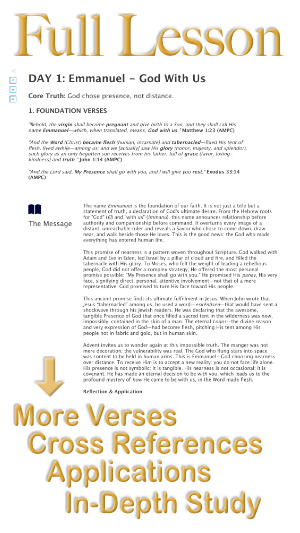
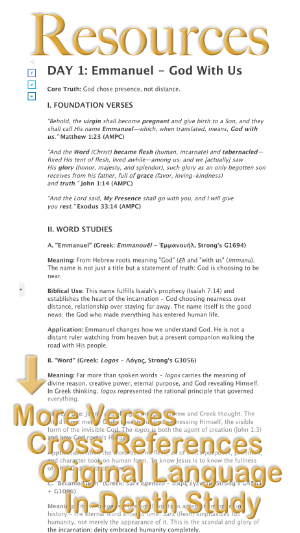
Unwrap Even MORE!
The Devotional Lesson is a nice break from your regular daily Bible study, but we never do any 'surface level' work, even for 'devotionals'. More in-depth study in the Full Lesson and if you are a serious Bible student, the Resources page may be a nice addition to your notes. (Use the buttons above to click over to the Full Lesson or Resource Page.)